
Enhanced Table Support: CSV Import and Visual Editing Made Simple (2025)
Discover how our new table features revolutionize the way you work with data in Markdown. From CSV imports to visual editing, creating and managing tables has never been easier.
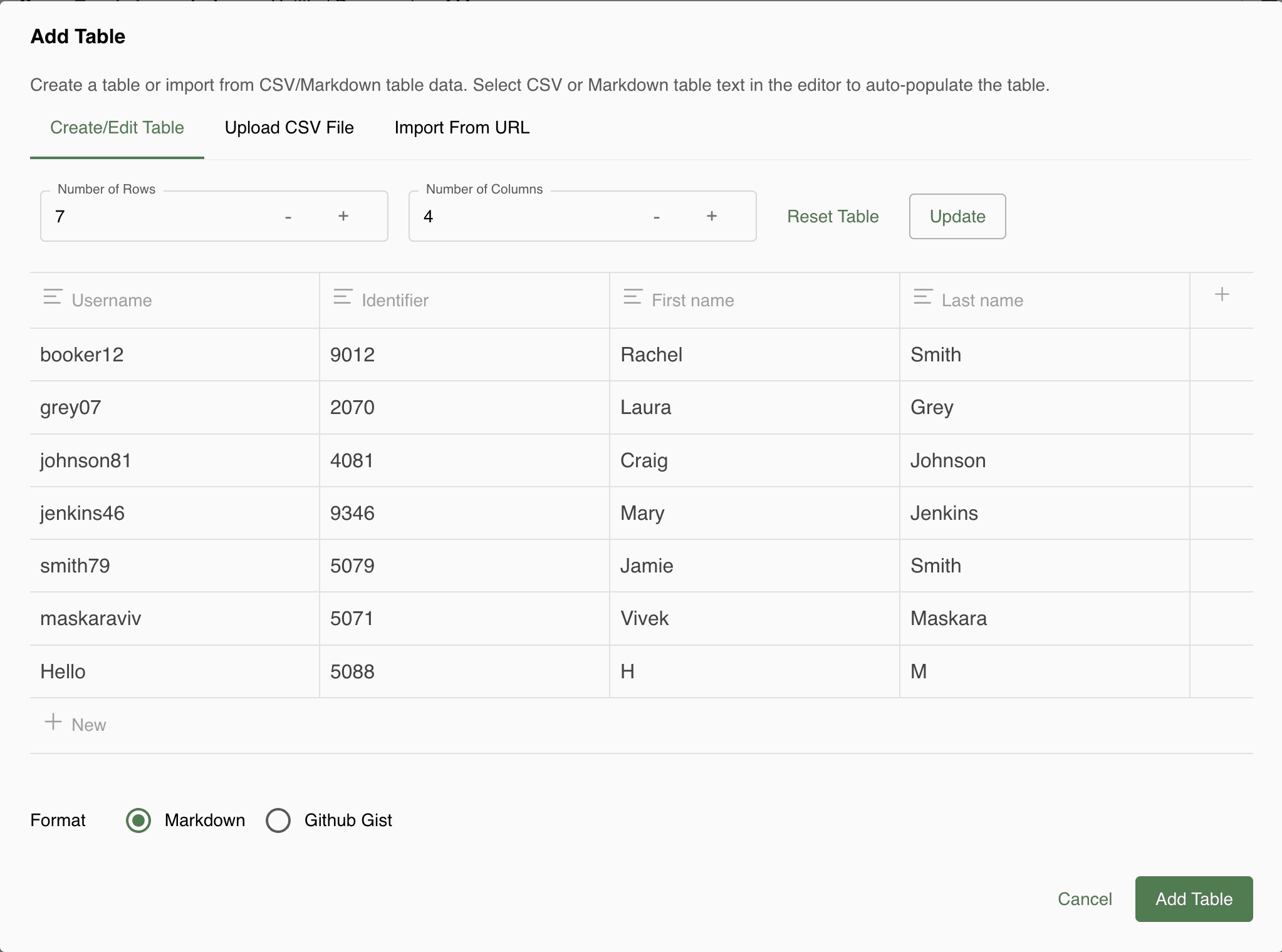
Let's be honest, creating tables in Markdown is tedious. You're either counting pipes and hyphens, or using some online generator and copy-pasting the result. Neither is fun.
We added table features to mdedit.ai that actually make sense: paste CSV data and convert it instantly, edit existing tables visually, or build new ones without touching the syntax. No more aligning pipes manually.
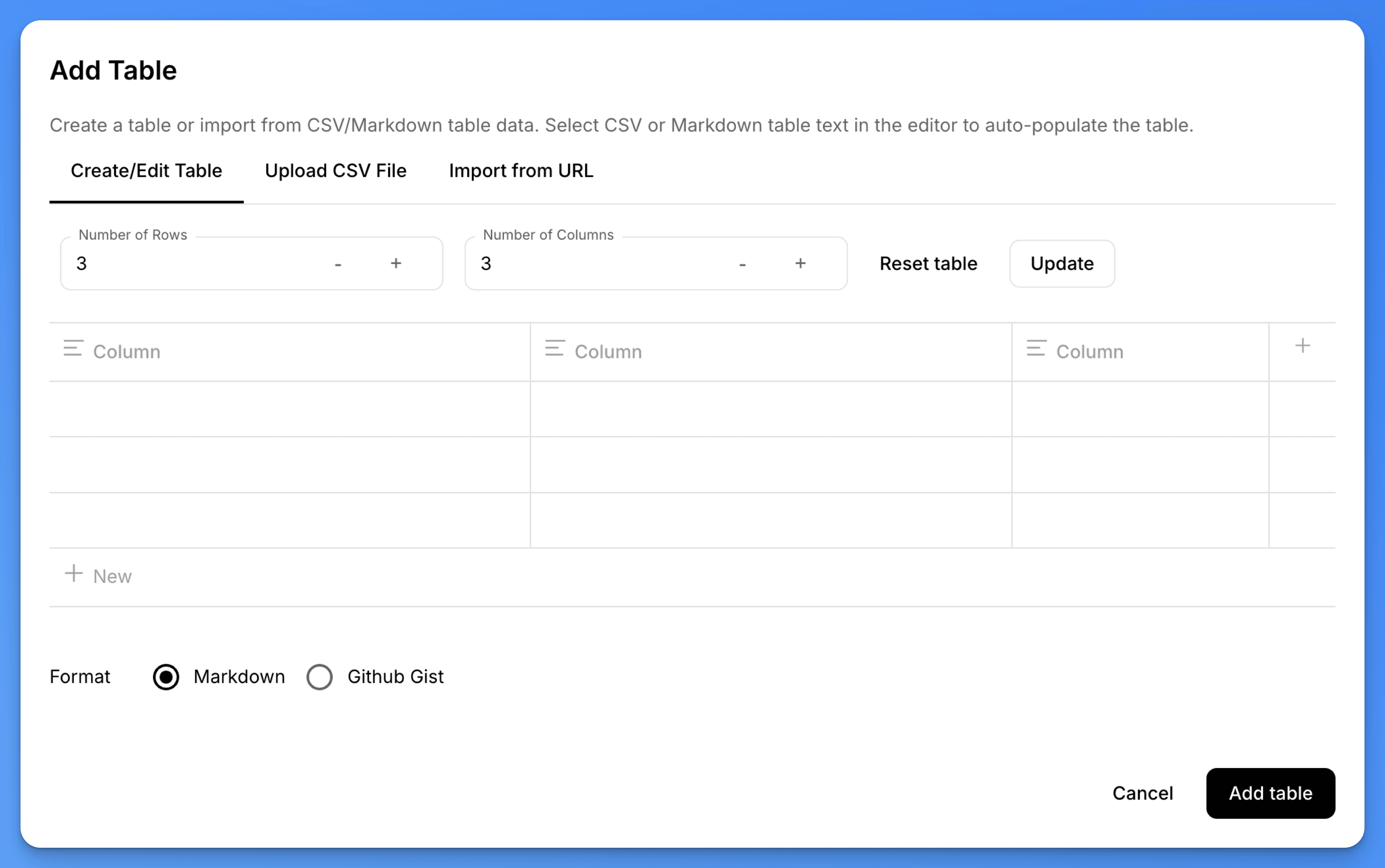
Table of Contents
Key Features
🔄 CSV to Markdown Conversion
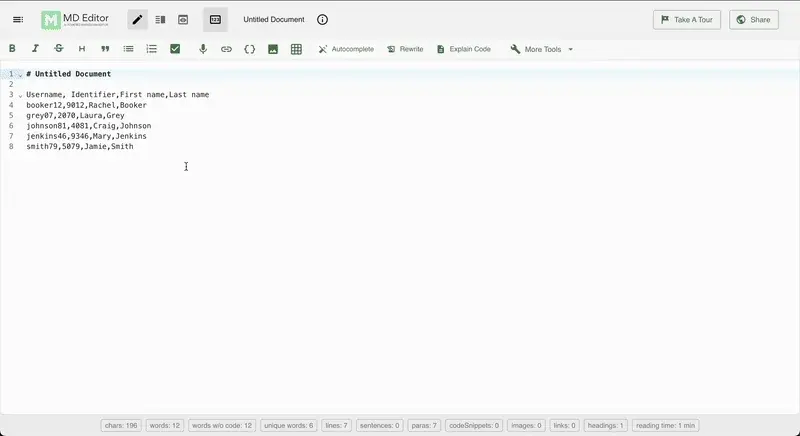
Transform CSV data into formatted Markdown tables instantly. Paste your CSV content, select it, and click the Table icon to open the visual editor.
✏️ Visual Table Editor
Edit existing Markdown tables using an intuitive visual interface. Select any table and click the Table icon to modify structure and content without touching Markdown syntax.
➕ Create Tables from Scratch
Build new tables using our table creation tool. Click Add Table to specify rows and columns, then use the visual interface to add content.
📁 CSV File Import
Import CSV files directly into the editor with automatic conversion to Markdown tables. Perfect for bringing in data from spreadsheets and databases.
🌐 URL-Based CSV Import
Fetch CSV data from any URL and convert it to Markdown tables. Great for working with publicly available datasets or remote data sources.
Output Formats
Standard Markdown: Clean, readable Markdown syntax that works everywhere - GitHub, static sites, documentation platforms.
GitHub Gist: Convert tables to GitHub Gists for easy sharing and embedding. Perfect for collaborative workflows and cross-document references.
Common Use Cases
- Project Management: Status tables, team assignments, milestone tracking
- Data Analysis: Import analytics results, create comparison tables
- Documentation: Feature tables, API references, configuration guides
- Content Creation: Blog tables, tutorials, educational content
Getting Started
- Try the CSV import feature with sample data
- Edit an existing table using the visual editor
- Create a new table from scratch
- Experiment with different output formats
The new table features save time and help you create better, more organized content.
Frequently Asked Questions
How do I convert CSV to Markdown table?
Simply paste your CSV data into the editor, select the CSV text, and click the Table icon in the toolbar. The visual table editor will open with your data converted to a Markdown table. You can then edit, format, and insert it back into your document.
Can I import CSV files from URLs?
Yes! mdedit.ai supports importing CSV data from remote URLs. Use the import feature, enter the URL of your CSV file, and it will automatically fetch and convert the data into a Markdown table.
How do I edit an existing Markdown table?
Select any existing Markdown table in your document and click the Table icon. This opens the visual table editor where you can add/remove rows and columns, edit cell content, and modify the table structure without writing Markdown syntax.
What's the difference between Standard Markdown and GitHub Gist output?
Standard Markdown creates clean pipe-separated table syntax that works on all Markdown platforms. GitHub Gist converts your table to a GitHub Gist, perfect for sharing, embedding, or referencing across multiple documents and projects.
Can I add or remove columns and rows in the visual editor?
Yes! The visual table editor provides intuitive controls to add or remove rows and columns. Simply use the add/delete buttons to modify your table structure, and all Markdown formatting is handled automatically.
Does the table editor support cell alignment?
Yes, the visual editor supports left, center, and right cell alignment. You can set alignment for entire columns, and the Markdown syntax (:---, :---:, ---:) is generated automatically.
Can I import large CSV files?
Yes, mdedit.ai can handle large CSV files. For very large datasets (thousands of rows), consider breaking them into smaller tables for better readability and performance in the final document.
How do I create a table from scratch?
Click the Add Table button in the toolbar, specify the number of rows and columns you want, and the visual editor will open with an empty table. Fill in your data using the visual interface, then insert it into your document.
Can I export tables to Excel or Google Sheets?
While mdedit.ai doesn't directly export to Excel format, you can copy the table data from the visual editor and paste it into Excel or Google Sheets. Alternatively, export your document to CSV format for spreadsheet compatibility.
Are tables responsive when exported to HTML or PDF?
Yes! When you export to HTML or PDF, tables are rendered with proper formatting and styling. HTML exports are responsive and mobile-friendly.
Related Articles
- AI-Powered Markdown Editor for Tech Writers - Explore all mdedit.ai features
- Tips and Tricks for Working with Markdown - Master Markdown syntax
- Revamped Share Experience Guide - Learn about export options
Try It Out
Next time you need a table in Markdown, give the visual editor a shot. Open mdedit.ai (no signup needed) and click the table icon. Way easier than wrestling with pipes and hyphens.